
Cottage Grove City Directory Holdings
Cottage Grove does not have a located, digitized Polk-style city-directory run. Its strongest historical directory shelf is instead the Minnesota Historical Society telephone-directory collection. The volumes can establish that a name, business, street, or telephone listing appeared at a particular time, but they are not a full census of every household. Check whether an issue is white pages, yellow pages, print, or fiche before drawing a conclusion from an absence.
| Collection | Years | Where Held | Access |
|---|---|---|---|
| Cottage Grove telephone directories | 1915; 1948; 1958-1964; 1966-1992; 1994-2011 | Minnesota Historical Society | Finding aid online; print and fiche holdings onsite |
| Thompson Grove telephone directories | 1960-1992 | Minnesota Historical Society | Separate historical locality heading |
| WCHS Name Index | 156 local source sets | Washington County Historical Society | Online finding aid; source material onsite |
| Historic newspapers and scrapbooks | Title and issue dependent | WCHS, Washington County Library, and online archive | Online and reading-room routes |
The MNHS telephone-directory finding aid is the starting catalog for the Cottage Grove and Thompson Grove shelves. It gives a researcher a year and call-number trail to confirm onsite rather than suggesting that a scanned local directory can be searched from home.
This MNHS finding-aid view shows the surviving volume and call-number information for the Cottage Grove collection.
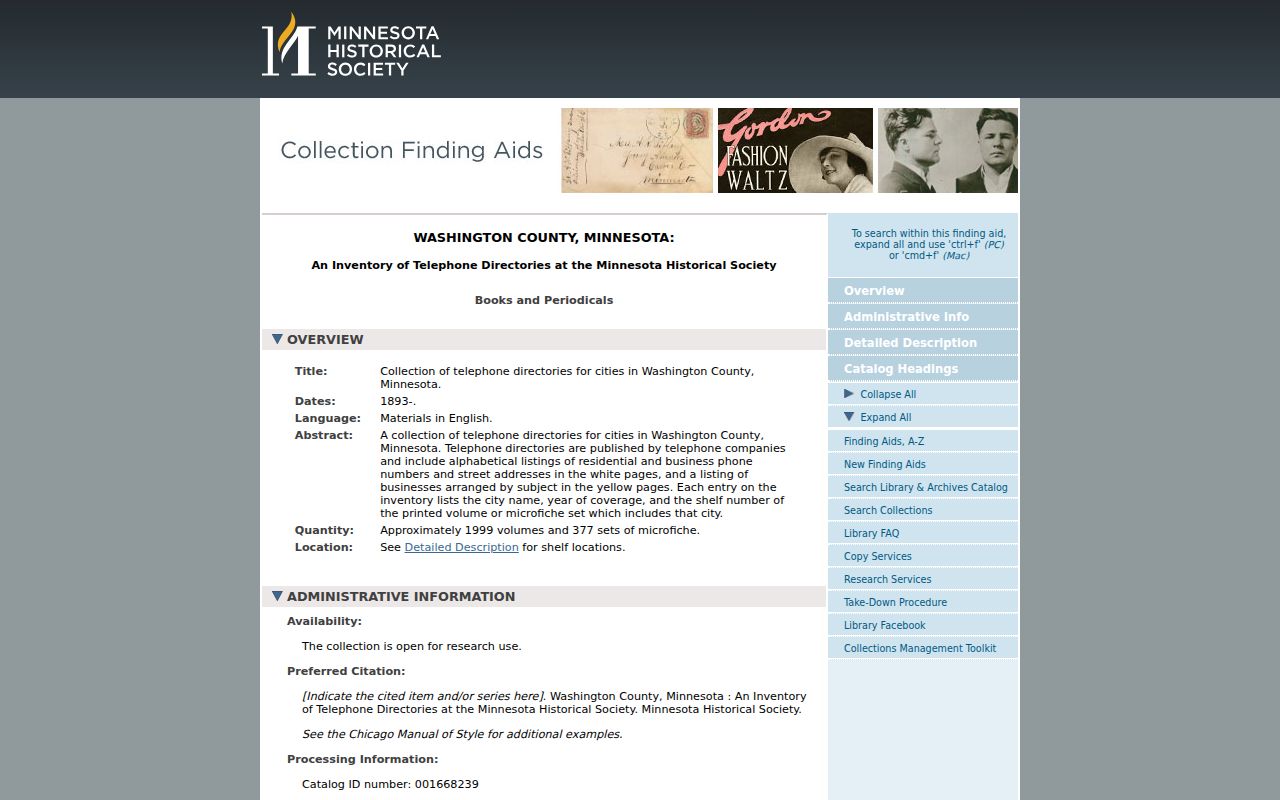
Use the displayed holding description to plan an onsite search, then record the exact heading, year, and call number in a research log.
Cottage Grove City Directory Year Breaks
The 1915 and 1948 volumes offer valuable early checks, but long gaps and changing coverage remain possible. The 1958 through 1964 run is especially useful because it overlaps the local construction surge documented for 1958 through 1960. A new street or repeated name during that period may reflect a new subdivision, a move, or the directory's coverage choices. It needs support from a plat, newspaper, tax record, or another dated item.
Later Cottage Grove telephone volumes continue through 1992 and then reappear in holdings from 1994 through 2011. Some listed issues are yellow-pages-only. A yellow-page absence says little about a household, while a white-page entry is still only a dated published listing. Keep the year printed on the volume alongside every transcription.
- 1915 and 1948: early surviving Cottage Grove telephone volumes.
- 1958-1964: a close sequence for checking the postwar growth period.
- 1966-1992: a longer run that overlaps village and city-era expansion.
- 1994-2011: later holdings with gaps and yellow-page variations.
Note: A missing name can mean an unlisted phone, a business entry, an exchange boundary, or a different historical locality label.
Cottage Grove City Directories and Thompson Grove
MNHS lists Thompson Grove separately for 1960 through 1992. That heading is an important historical search term, not a spelling error to erase. Search both Cottage Grove and Thompson Grove when a surname or street does not appear where expected. Older material can also use Cottage Grove Township, Grey Cloud Island, a rural route, or Washington County rather than the city label used today.
Local history gives those alternatives context. James Sullivan Norris claimed the Cottage Grove farm in 1842, and the Furber family settlement and the old village predate later municipal labels. Lyceum Hall served as a library, town-meeting space, and newspaper home. Those terms can help a researcher locate a local-history source or newspaper mention when a telephone listing does not answer the question.
Washington County Historical Society's research collections bring together the kinds of local sources that complement a city directory: community files, plats, photographs, cemetery material, newspapers, and family records.
When the directory trail stops, the collection categories suggest a next source without turning an old printed entry into a present-day profile.
Reading a Cottage Grove City Directory
The surviving Cottage Grove material is mainly telephone-directory evidence, so its layout should be read on its own terms. The MNHS finding aid does not promise a standardized city-directory entry with a spouse, ownership mark, or street-order section. First identify the volume's title, year, locality heading, and white-page or yellow-page status. Then capture only the fields visible on the page and avoid reposting an old telephone number.
| Printed heading | Whether the volume says Cottage Grove, Thompson Grove, or another locality. |
|---|---|
| Year and format | The issue year plus print, fiche, white-page, or yellow-page status. |
| Listed name or business | A dated listing, not proof of an identity beyond that publication. |
| Street or locality text | Address detail only where the volume actually prints it. |
| Call number and page | The citation that lets another researcher inspect the same item. |
- Criss-cross directory
- A directory arranged by street or address rather than by name. Research did not confirm a criss-cross section for every Cottage Grove holding.
- Householder index
- A name arrangement for household listings. A telephone volume may be less complete and differently organized than a householder index.
- Abbreviation key
- The page in a volume that explains its shorthand. Photograph it before interpreting an unfamiliar mark.
Cottage Grove City Directory Index Leads
The WCHS Name Index is a separate route when a telephone volume is missing or too thin. It requires a last name, accepts an optional first name, supports partial terms, and encourages spelling variations or initials. The result identifies a source title rather than supplying a complete transcript. At inspection, it covered 156 local sources and about 182,577 listings.
For Cottage Grove research, source titles can point to Atkinson Cemetery, Cottage Grove Cemetery, United Church of Christ Cemetery, the Poor Farm register, school material, biographical files, and local histories. Search a surname first, inspect the cited source type, and then make an appointment, call, email, or request WCHS research assistance for the original context. The Goodman Research Center is the archive route for sources that are not online.
This is especially useful for a person who appears in a cemetery, school, or local-history source but never had a publicly listed phone. It is a research lead, not a replacement city directory.
Cottage Grove City Directories in Newspaper Context
A directory year gains meaning when compared with a contemporaneous notice. The Stillwater Area Historic Newspaper Initiative provides free online access to more than 176,000 pages of Washington County newspapers, while WCHS holds bound local titles and scrapbooks. Search a surname with a street, farm name, church, organization, subdivision, or legal-description phrase. Read the date and the full item before connecting it to an address.
Washington County Library adds another access channel. Its genealogy resources identify newspaper databases, historical periodicals, and workstation research tools, and library microfilm readers are available at R.H. Stafford Library and the Government Center Law Library. Those channels can fill an index gap without pretending every historical source is digitized or remotely available.
WCHS also holds bound Post-Messenger, St. Croix Valley Press, and South Washington County Sun material. Its research route includes an appointment at the Goodman Research Center, phone or email confirmation before travel, and mail research for a defined question. Give staff the surname, place term, date range, and source type where known. A request for an identifiable item is more likely to reveal useful context than a request for every person connected to a street.
Tracing Cottage Grove City Directories
Build a household trail one date at a time. Start with the earliest likely volume, preserve the heading exactly as printed, and compare the next available year rather than assuming every year exists. A later street record may need the current address system, but historical notes should retain the township, rural-route, or Thompson Grove wording that the source used. The historical collections can be paired with the current address route only when the question changes from a past listing to a parcel record.
- Search the surname and its spelling variants in the Cottage Grove and Thompson Grove holdings.
- Record the year, listing type, page, call number, and any visible locality or street text.
- Check the next available directory year and describe the result as a dated change, not an unexplained gap.
- Pair an appropriate directory period with state or federal census research through MNHS or library access.
- Use a newspaper, cemetery register, plat, or local-history source as an independent corroborator.
MNHS People Records can provide statewide historical index leads, while the Gale Family Library supplies in-house database and microfilm access for some gaps. A family name that disappears from a telephone volume might have moved, changed listing status, used a business listing, or been listed under another locality. It should never be treated as a conclusion by itself.
Keep an archive-quality citation for each hit: source title, official URL, access date, exact search wording, publication year, page or call number, and the limited fact it supports. This is important because the newspaper archive is expanding and online finding aids can change while the physical volume remains the controlling evidence.
For a difficult surname, repeat the search with an initial, a spelling variant, and the printed locality label. A citation that says only “Cottage Grove” loses the feature that may distinguish a Thompson Grove entry, a rural-route notice, or a village-era reference. Those distinctions are often the bridge between a shelf record and the correct historical map.
Cottage Grove City Directory Limits
A telephone book is historical evidence, not a current roster. It can omit people who had no listed number, use an incomplete exchange, or contain a business listing rather than a household entry. Cemetery, obituary, school, and newspaper sources also answer narrow historical questions. Keep the source date and its exact claim separate from the person being researched.
For a current parcel, road, or address question, the county systems are more suitable than a historical volume. For a dated address trail, see the Cottage Grove previous residents record path, which uses directories as one layer rather than treating them as a complete list.