
Cottage Grove Resident Lookup Records
No single-person city directory exists for Cottage Grove. So a smart search splits the question from the source. A parcel record names a property and its tax-owner display. A deed records a title event. A court entry marks a public proceeding. Historical indexes can place a name in a particular year. None of that proves where someone lives today. Begin with the narrowest lawful fact you already hold. That could be a street, a PIN, or a filing year. Then compare at least two independent records before you treat similar names as one person. Neighbors, past residents, and current owners each surface in different rolls.
| Record | What It Confirms | Where | Access |
|---|---|---|---|
| Parcel, tax, and GIS record | PIN, situs address, parcel context, and tax-owner display | Washington County property search and maps | Address or PIN search; owner is not necessarily an occupant |
| Recorded deed | Recorded transfer, parties, and legal description | Washington County RecordEASE | Online detail is stated for 1984-present; older work uses the research room |
| Public court case | Named party, public case event, and case status | Minnesota Court Records Online | Public results only; classification and older-coverage limits apply |
| Vital index or certificate route | Historical life event or relationship | MDH, Washington County, and MNHS | Eligibility and public-status rules vary by record |
| Credential or business record | Professional credential or entity filing | Minnesota boards, agencies, and Secretary of State | Role-specific result, not address proof |
Match your starting point to what you know. A known street points to county address and PIN tools. An old name points to an event date or an archive index. A public court question starts with a surname and first name, sharpened later by a date or court filter that fits the question. Every piece of evidence should state what it proves and when. Remember the roles stay separate: a mail address, a tax owner, an applicant, a contractor, a credential holder, and a resident are not the same thing.
Cottage Grove Court Name Lookup Fields
Minnesota Court Records Online goes by MCRO. It offers four entry modes: Name, Case Number, Citation Number, and Attorney. Try an exact first and last name first. Unsure of the spelling? A trailing asterisk works after at least two characters. The separate Sounds Like setting cannot join a wildcard, so pick one approach per search. Add a date of birth or a date-filed range only when you legitimately know it. Select Washington County or a case category only when it truly matches your record question.
| MCRO field | Use for a careful name search |
|---|---|
| Name Type and last, first, middle name | Set the party-name form and begin with the most complete spelling available. |
| Sounds Like or wildcard | Use one spelling aid at a time. Sounds Like is a checkbox; a wildcard follows at least two characters. |
| DOB and Date Filed | Use exact values or ranges only as an identity check, not to broaden a speculative search. |
| Case Category and Case Status | Narrow to Civil, Criminal, Family, Probate, Mental Health, or status when the purpose supports it. |
| Court location | Choose statewide or a specific location such as Washington County and retain the search scope with the result. |
MCRO is a public-access route, not a biography. Records from before July 1, 2015 face limits. Juvenile, sealed, expunged, adoption, and other confidential material never appears as ordinary public output. Courthouses do offer a public court terminal outside juvenile settings. For a specific public file, Washington County Court Administration takes requests by phone, in person, or by mail. You supply a case number, an approximate year, a document name, and a plain or certified-copy choice.
Cottage Grove Resident Lookup Results
Read the result screen before concluding anything. A court hit marks a proceeding. It is not a current address or a final judgment about a person. Capture the exact spelling you searched. Note the filters, the result count, the court location, and the access date. Those details let you repeat the check later and separate people who share a name.
| Public MCRO result field | What it shows |
|---|---|
| Case number | The identifier needed for a focused record or copy request. |
| Party names and roles | The names appearing in the case and their stated roles. |
| Court location and category | Which court handled the public case and its record category. |
| Filing date and case status | When the case was filed and the public status shown at the time searched. |
| Docket events and public documents | Publicly visible event entries, document links, and a disposition when one is public. |
A docket is the court's event list for a case. It helps you locate a filing or a copy. Yet it can omit confidential material and may include same-name strangers. Washington County Court Administration's official copy-fee material lists plain copies as free. Certified copies run $14. Mail requests may take five business days. Microfilm files can take longer. Confirm the current court route and fees before you order.
Verifying a Cottage Grove Resident Match
Verification means linking dated records, never stretching one match into a claim of present residence. A parcel's situs location can anchor a street question. An historical index or a public court case adds a separate date and identifier. For each step, record the source, the query, the result ID, and what turned up empty. A good worksheet keeps current and historical evidence in separate columns, because a directory entry, a deed grantee, and a later tax display may describe entirely different moments in time.
- Start with the normalized address or name already known. In the county property tools, record the PIN, situs address, parcel shape, tax year, and displayed ownership role without treating it as occupancy.
- Use the name and a legitimate time or location limit in MCRO. Compare the public case number, party role, category, and filing date instead of relying on the name alone.
- Check a historical vital or archive index for an event date, relationship, or locality. An event county is not necessarily a residence county, so keep that distinction in the notes.
- Request a specific public court or vital copy only from its custodian and only when the record is public or the requester meets the eligibility rule. Keep the record number and copy type with the request.
- Docket
- A chronological court event record for one case. It can identify filings and hearings but does not expose confidential material.
- Index vs. image
- An index supplies searchable fields or a record lead. An image is the scanned instrument or document and may have separate access, cost, or redactions.
- Certified copy
- A custodian-issued copy carrying the certification required for uses that need official authentication. It is different from an informational or plain copy.
Cottage Grove Vital Record Lookup Rules
Vital records work differently from a residents directory. A birth or death entry is an event record, not a residence roll. The Minnesota Department of Health holds births from 1900 and deaths from 1908. MNHS People Records adds historical indexing. Births run 1900 through 1934; deaths run 1904 through 2001, with gaps noted. A match can hand you a certificate number or a mother's maiden name. Remember one limit. The county of birth or death does not prove where the person lived.
Marriage certificates follow the county that issued the license. Washington County covers licenses issued there from 1870 to the present, wherever the ceremony took place. It charges a $10 certificate-request fee. Divorce decrees belong to the district court that heard the case. Minnesota Statutes section 144.225 lets MDH control which birth records are public. Some stay confidential. Certified birth copies carry eligibility rules. Noncertified death records are public. Certified death copies are restricted. Adoption records stay sealed too. Original birth records and related correspondence remain closed. Defined MDH routes exist for requesters who qualify.
MDH takes ordinary certificate orders by mail or fax. It notes that county offices are often faster. If a form requires notarization, the signature must be notarized. An in-person county applicant simply signs before staff. MNHS indexes can be searched online. Later or incomplete historical work may call for the Gale Family Library, library microfilm, newspapers, cemetery materials, or Washington County Historical Society research. For a marriage certificate, use the issuing county's service form. For a divorce decree, use the court's copy route.
Cottage Grove Role-Specific Lookup Records
A state license confirms a credential, not a home. It can prove professional standing when the official record names both the person and the place. It cannot prove a residential address. Minnesota's health-occupations verification accepts last name, first name, city, county, state, occupation type, credential status, discipline, and Minnesota credential number. The Secretary of State business search works by business name or file number, and its detailed filing record can show an entity's status and history. Keep the two threads separate. Treat each tool as professional-record evidence. The Minnesota health-occupations verification shows the structured field choices available for a role-specific search.
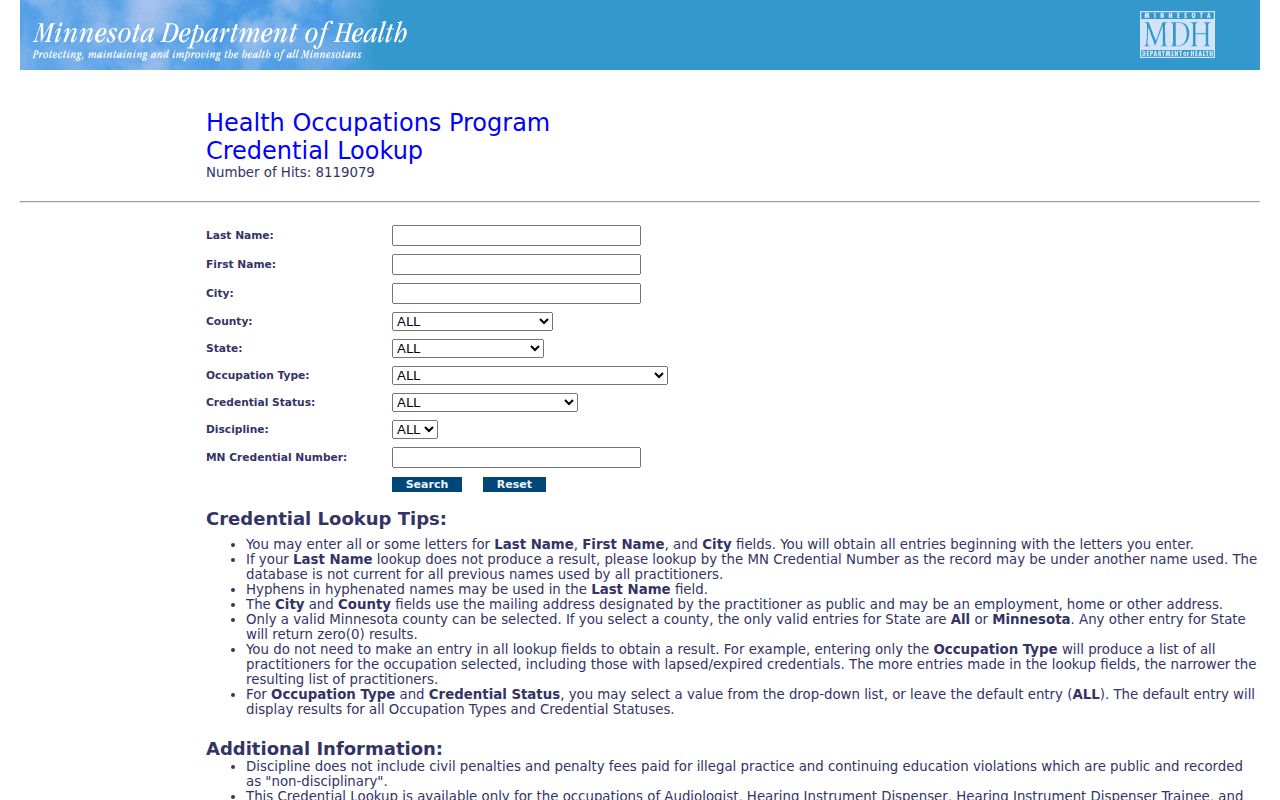
The form supports a credential check by name, place, occupation, status, or credential number. Read it as professional-record evidence. It is not a resident listing. Other official routes stay just as narrow. The Department of Labor and Industry offers license and registration criteria. The Medical Board can search a practitioner by name. It also works by city, license, specialty, or ZIP. The Department of Agriculture searches by license, name, city, county, or program. Cottage Grove has no local-licensee name directory. City Clerk categories work better as a targeted public-record request by category and date.
Cottage Grove Historical Name Lookup
A dated Cottage Grove connection often starts with the Washington County Historical Society Name Index. Underneath it sit cemetery, biographical, school, newspaper, and local files that supply real leads. Search spelling variants. Follow the named source. An index result is a lead, not a full transcript. MNHS holds telephone directories for Cottage Grove across several years. The Thompson Grove heading is a useful historical locality variant, and older records near Grey Cloud Island may carry a different locality label too, since township and city boundaries changed.
Local newspapers, cemetery registers, and library collections can corroborate a date, a relationship, or a historical address. Leave sensitive details out. Phone numbers and the like stay unpublished. Write a negative result narrowly. Name the source, the spelling, and the date range tried. A miss proves little. It does not show a person never lived in Cottage Grove.
Cottage Grove Resident Lookup Limits
Access in Minnesota runs through the Government Data Practices Act, Minnesota Statutes chapter 13, by record classification. Public data is free to inspect. Copies, compilation, or transmission may carry costs. A denial must cite its legal authority. Voter data is tightly controlled. There is no public name-only state voter portal. MNVotes and Poll Finder work from address and registration details. A voter list takes the statutory request process and a permitted-use statement under section 201.091.
Protected voters, Safe at Home participants, confidential vital records, sealed adoption material, and nonpublic court records are limited by design. Never try to reconcile an alternate address with other sources to expose a protected location. Send any correction request to the responsible data custodian. Keep the source date. Ask for an existing record and time period, not a new list of people.
Lawful use. Use official records for personal, lawful research and record navigation. Do not use names, addresses, or protected-record gaps to stalk, harass, threaten, intimidate, or bypass an address-confidentiality program.